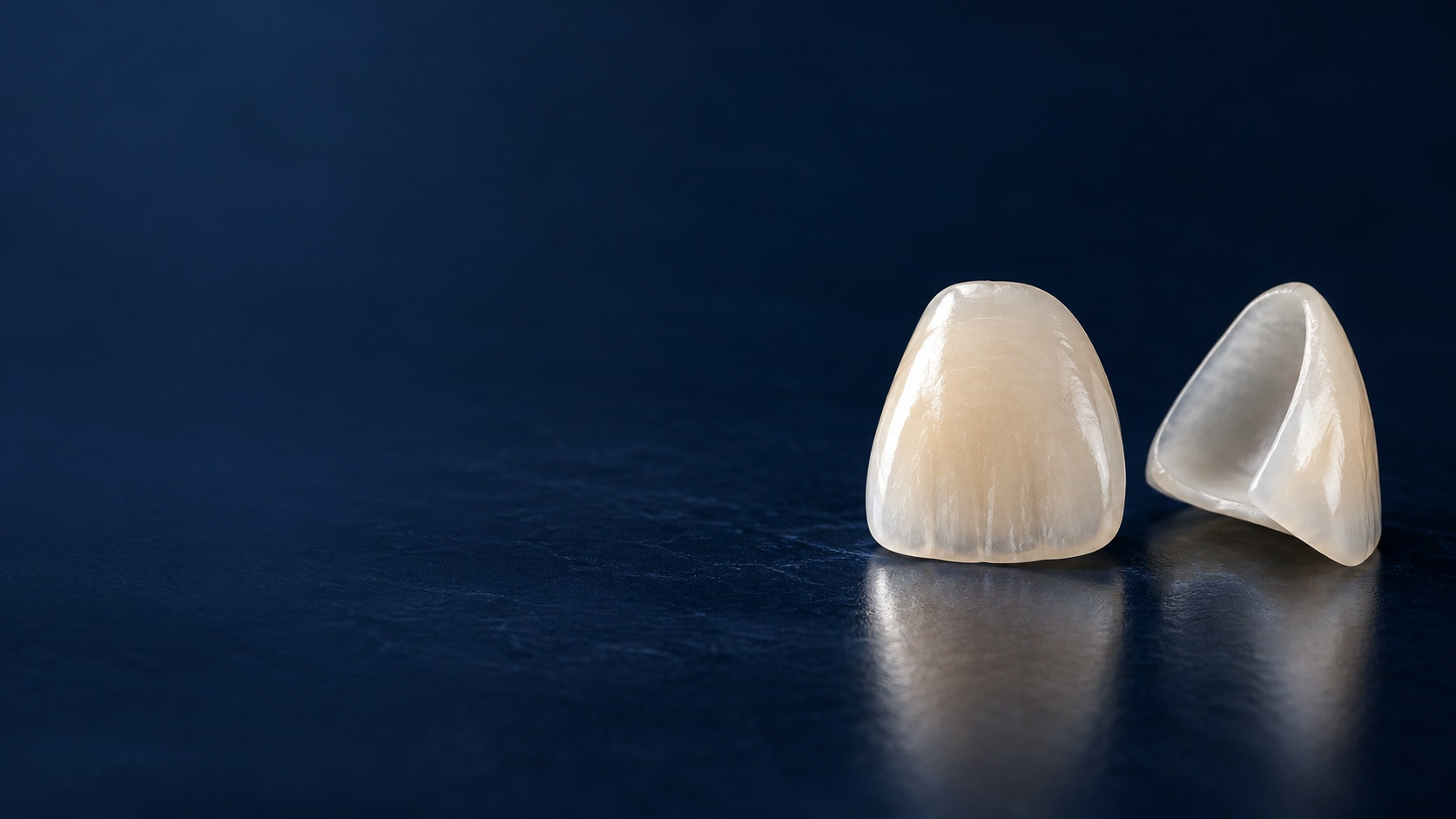
If you feel self-conscious about chipped, stained, uneven, worn or slightly gapped teeth, dental veneers can help improve the shape, colour and overall balance of your smile. At R&G Dental in Didsbury, Manchester, we create personalised veneers that are planned around your facial features, existing teeth and desired result, so your smile looks refined, natural and still feels like you.




Dental veneers are thin, custom-made coverings placed over the front surface of teeth to improve their shape, colour, size and overall appearance. They are commonly used to improve teeth that are chipped, stained, worn, uneven, slightly misaligned or affected by small gaps.
Veneers can be made from materials such as porcelain, composite resin or zirconia, depending on your needs and the result you want to achieve. At R&G Dental, your treatment is carefully planned around your natural teeth, bite and facial features to create a smile that looks balanced rather than artificial.
Unlike crowns, veneers usually cover only the visible front surface of the tooth, which means less of the natural tooth structure may need to be altered in suitable cases.
What Can Veneers Improve?
Ready to Explore Veneers in Manchester?
Book a consultation at R&G Dental to discuss your smile concerns and find out whether veneers are the right option for you.
Porcelain vs Composite vs Zirconia Veneers
How Your Veneer Treatment Works at R&G Dental
Consultation and Smile Assessment
We begin by examining your teeth and gums and discussing what you would like to improve about your smile. We also assess your bite, tooth position, enamel and overall oral health to determine whether veneers are the right option for you.
Planning Your New Smile
We plan the shape, shade and proportions of your veneers so they complement your surrounding teeth and facial features. Where appropriate, we may use digital scans, photographs or impressions to help us design a natural-looking and balanced result.
Preparing Your Teeth
If preparation is required, we carefully remove only the amount of enamel needed to create space for the veneer. The level of preparation depends on your teeth, the veneer material and the result we are aiming to achieve. Some cases may require very little preparation.
Taking Digital Scans or Impressions
For laboratory-made porcelain or zirconia veneers, we take detailed scans or impressions of your teeth. These are used to create veneers that are individually made to match the planned shape, shade and fit of your smile.
Temporary Veneers, If Needed
If your teeth have been prepared while your final veneers are being made, we may provide temporary veneers to protect the teeth and maintain the appearance of your smile during this stage.
Fitting Your Veneers
Once your veneers are ready, we carefully check their fit, colour, shape and overall appearance before bonding them securely to your teeth. We also check your bite and make any necessary adjustments to ensure the veneers feel comfortable.
Veneers Cost in Manchester
We offer transparent pricing for dental veneers at R&G Dental in Manchester. The final cost of your treatment will depend on the type of veneer and the number of teeth being treated.
Trusted by Patients Across Manchester
Discover What Veneers Could Do for Your Smile
Whether you want to improve chipped, stained, uneven or gapped teeth, we can create a personalised treatment plan based on your smile and goals.
Frequently Asked Questions About Veneers
Do veneers damage your natural teeth?
Veneers should not damage healthy teeth when they are appropriately planned and fitted. However, some types of veneers require a small amount of enamel to be removed so the restoration can sit naturally on the tooth. Because enamel does not grow back, porcelain veneer treatment should be considered a long-term commitment. The amount of preparation required varies from person to person, and not every veneer requires the same degree of tooth preparation. The NHS guide to dental veneers also explains that some veneers involve removing a small amount from the front of the tooth, while others may require little or no drilling.
Does getting veneers hurt?
Veneer treatment is generally well tolerated. If tooth preparation is required, local anaesthetic can be used to keep you comfortable during the procedure.
Some patients may notice temporary sensitivity after their teeth have been prepared or after the veneers are fitted, particularly to hot or cold foods and drinks. This usually settles, but any persistent discomfort should be assessed.
Are veneers permanent, and can they be removed later?
Porcelain veneers should usually be considered a long-term and often irreversible treatment because some enamel may need to be removed before they are fitted. If a veneer eventually fails or needs replacing, another restoration will generally be required to protect and restore the prepared tooth.
Composite treatments may sometimes involve less alteration to the natural tooth, but whether a treatment is reversible depends on how the tooth has been prepared. This is one reason we discuss conservative alternatives before recommending veneers.
How long do porcelain veneers last?
There is no fixed lifespan that applies to every veneer. Longevity depends on factors including the material used, the amount of natural enamel available for bonding, your bite, oral hygiene, teeth grinding and how well the veneers are maintained.
Long-term clinical research shows that well-planned ceramic veneers can have high survival rates over many years, particularly when they are bonded mainly to enamel. A recent systematic review reported strong long-term survival for several established ceramic veneer materials, although outcomes vary between patients and materials.
Can veneers stain or change colour?
Porcelain and zirconia are highly resistant to staining compared with natural teeth and composite resin, but the teeth and areas around the veneers can still be affected by plaque, surface staining and changes in the surrounding natural teeth.
Composite veneers are more likely to pick up staining over time, particularly with frequent coffee, tea, red wine or tobacco use. Regular cleaning and professional dental hygiene appointments can help maintain the appearance and health of your smile.
Can veneers be whitened if I want a brighter smile later?
Whitening gels lighten natural tooth structure but do not whiten porcelain, zirconia or composite restorations in the same way. This means an existing veneer will generally remain its original shade while the surrounding natural teeth may become lighter.
If you are considering both veneers and whitening, it can therefore make sense to complete professional teeth whitening first. Once the natural teeth have reached the desired shade, we can match the veneers more accurately to your smile.
Can you still get tooth decay underneath a veneer?
Yes. A veneer covers the visible front surface of the tooth but does not make the natural tooth immune to decay. Decay can still develop around the margins of a veneer or on other exposed parts of the tooth if plaque is not controlled.
Brushing twice daily, cleaning between your teeth and attending regular dental examinations and hygiene appointments remain important after veneer treatment.
What happens if a veneer chips, cracks or comes off?
A damaged veneer should be checked rather than ignored. Depending on the material and extent of the damage, a small chip may sometimes be repairable, while a significantly fractured or debonded ceramic veneer may need to be replaced.
Avoid trying to glue a veneer back yourself. Keep the veneer if it has come away completely and contact us so we can assess both the restoration and the tooth underneath.
Clinical reviews recognise fracture, chipping and debonding as possible complications of ceramic veneers, although overall long-term survival can be high when treatment is appropriately planned.
Can I have veneers if I grind or clench my teeth?
Possibly, but teeth grinding needs to be assessed before treatment. Repeated heavy forces from grinding or clenching can contribute to tooth wear and may place additional stress on veneers.
If we identify signs of bruxism, we may recommend managing the grinding and, in some cases, using a protective night guard after treatment. The NHS guidance on teeth grinding explains that bruxism can contribute to worn or broken teeth and that dentists may recommend a protective mouth guard or splint.
Can veneers fix crooked teeth?
Veneers can sometimes improve the appearance of teeth that are only mildly rotated, uneven or out of alignment. However, they do not physically move the teeth in the way orthodontic treatment does.
If teeth are significantly crowded or misaligned, straightening them first may allow us to create the desired result while preserving more natural tooth structure. In these situations, we may discuss Invisalign clear aligners before considering veneers.
Can veneers close gaps between my teeth?
Small gaps between teeth can often be reduced or closed with veneers by carefully changing the width and shape of the teeth.
However, veneers are not automatically the best treatment for every gap. Depending on the size of the space and the position of the teeth, options such as composite bonding or Invisalign may provide a more conservative solution.
Can I get just one veneer, or do I need veneers on all my front teeth?
You do not necessarily need veneers on every visible tooth. A single veneer may be used to improve one chipped, discoloured or unusually shaped tooth, while other patients may choose several veneers to create greater symmetry across their smile.
The number of veneers we recommend depends on your smile line, the condition and colour of the surrounding teeth and what you would like to change. Our aim is to treat only the teeth that genuinely need treatment rather than automatically recommending a full set.
Are porcelain veneers better than composite veneers?
Neither option is automatically better for every patient.
Porcelain veneers generally provide excellent colour stability, natural translucency and established long-term performance. Composite veneers can often be completed with less tooth preparation, are usually easier to repair and may require fewer appointments.
The right choice depends on your teeth, budget, cosmetic goals and how much alteration is required. We will discuss the advantages and limitations of each material before treatment.
Should I choose veneers or composite bonding?
Composite bonding may be a good option when you want to repair smaller chips, close minor gaps or improve tooth shape with minimal alteration to the natural tooth. It can also usually be repaired relatively easily if it chips.
Veneers may be considered when more substantial changes to colour, shape or symmetry are required or when a ceramic restoration is preferred.
What is the difference between a veneer and a dental crown?
A veneer mainly covers the visible front surface of a tooth and is commonly used to improve appearance. A crown covers substantially more of the tooth and is generally used when a tooth needs additional structural protection because it is weakened, heavily restored or significantly damaged.
If the main issue is cosmetic and the tooth is otherwise healthy, a veneer may be considered. If the tooth needs greater protection, one of our dental crown treatments may be more appropriate.
Can I have veneers if I have gum disease?
We would normally want your gums and teeth to be healthy before beginning elective veneer treatment. Inflamed, bleeding or receding gums can affect treatment planning, appearance and the long-term health of the teeth supporting the veneers.
If we identify concerns with your gums, these should be addressed first. We may recommend a periodontal assessment at R&G Dental before proceeding.
The NHS guidance on gum disease explains that untreated gum disease can lead to gum recession, loose teeth and loss of supporting tissues, which is why good periodontal health matters before cosmetic treatment.
Should I whiten my teeth before getting veneers?
If you would like your natural teeth to be lighter, whitening is usually worth considering before the final shade of your veneers is selected.
Veneers do not respond to whitening in the same way as natural enamel, so whitening afterwards could leave your surrounding teeth lighter than the veneers. Completing teeth whitening at R&G Dental first allows us to plan the veneer shade around the colour you want to maintain.
How long does veneer treatment take?
The timeframe depends on the type of veneer and the number of teeth being treated.
Porcelain and zirconia veneers usually require more than one appointment because the teeth need to be assessed and planned, scans or impressions are taken, and the final restorations are custom-made before fitting. Temporary veneers may be used where appropriate while your final restorations are being produced.
Composite veneers can often be completed more quickly because the material may be shaped directly onto the teeth. We will give you a clearer treatment timeline once we have assessed your smile.
How much do veneers cost in Manchester?
At R&G Dental, porcelain veneers are £750 per tooth and zirconia veneers are £850 per tooth. Your overall treatment cost will depend on the material selected and the number of teeth being treated.
You do not always need veneers across your entire smile. During your consultation, we will assess which teeth actually require treatment and discuss suitable alternatives where they may preserve more natural tooth structure. For patients considering several cosmetic treatments together, a personalised smile makeover can combine options such as veneers, bonding, whitening or teeth straightening.
Take the Next Step Towards a More Confident Smile
Speak with our team about porcelain or zirconia veneers and explore a treatment approach designed around your natural teeth and desired result.